

The imperative to decarbonise the global shipping industry is clear and present, however, many of the world’s largest importers and exporters are insufficiently informed about the full implications of the forthcoming new emissions regulations and the billions of dollars that will be added to freight costs in the future.
Pressure to decarbonise and reduce emissions of greenhouse gases (GHG) is growing in all sectors. In shipping, the International Maritime Organisation’s target to reduce GHG emissions by 50% by 2050 (from a 2008 baseline) will be complemented by regional and national regulations.
Besides regulatory changes resulting from decarbonisation policies, emissions limits and related taxes, there will be enormous technological change in the design of ships and their propulsion systems, with a transition to engines powered by low or zero carbon fuels.
“Overall, the transition towards low or even zero carbon shipping will result in higher costs and we believe that we have put together the first independent cost model to help shippers forecast and quantify additional medium-term direct costs, where they apply,” said Philip Damas, managing director of Drewry.
The European Union will be the first region to enforce ‘carbon taxes’ in shipping via its Emission Trading System, which will penalise users of high-carbon fuels such as conventional fossil fuels and apply not only to shipments within Europe, but also to all shipments to and from Europe.
As shipowners look to comply with tighter environmental rules, several ’candidate’ green fuels are being considered, and they will have different implications and costs for shipping lines and for shippers. Drewry experts have consulted ocean carriers and representatives of shippers and industry associations. This has enabled Drewry to design a new Carbon Tax and New Fuel Forecasts tool, which provides forecasts based on the ’most likely’ regulations, using 3 scenarios of future carbon taxes, and using 3 ’most likely’ new green fuel types (Liquefied Natural Gas, green methanol and green ammonia).
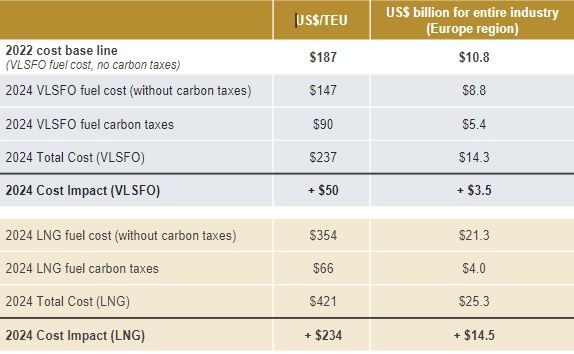
Drewry announces today the first industry-wide costing of both the European carbon taxes and for transitioning all European container shipments to a greener fuel type. The cost for 2024 ranges between $3.5 billion and $14.5 billion depending on the extent to which the industry switches to LNG and other greener ships instead of keeping to conventional fuel oil. See below:
Base Line and 2024 Cost Impact Forecasts for VLSFO and LNG
Sources: Drewry, IMO, European Commission
Note: Based on forecast EU allowance price of 200 euro/tonne and on 100% implementation of taxes on intra-EU shipping and 50% implementation on shipping to/from the EU
* Assuming that ships buy LNG fuel at the average cost of regions at both ends of the route (Europe, Asia and the US)
LNG is the main ‘intermediate’ fuel type on the journey to decarbonise container shipping. Technology and fuel supply infrastructure are currently not ready for either green methanol or green ammonia. Though future LNG prices will be heavily dependent on the ultimate future energy market.
The European Union Commission and Parliament have considered introducing new carbon taxes as early as next year, but it is now expected the new taxes will not come into effect until 2024.
In July, Maersk announced it was planning to introduce surcharges of 170 euros/40ft container for its Asia to North Europe services and 185 euros/40ft for North Europe to US services, thereby passing-on the extra regulatory costs. Last week, MSC announced that it was planning to introduce surcharges of about 138 euros/40ft container for its Asia to North Europe services. Other major carriers, however, have yet to announce their intentions following the regulatory changes.
Drewry will continue to work with shippers to inform them of the major cost, compliance and contractual implications of new sustainability rules, and will partner with expert organisations to provide specialist support in this complex area. Drewry urges ocean carriers to be as transparent with shippers as possible about the costs associated with sustainability, while retaining confidentiality over any sensitive, technology-related data.
Earlier this year, Drewry signed a partnership agreement with Smart Freight Centre, an international non-profit organization focused on reducing greenhouse gas emission from freight transportation. Drewry has also formed an Environmental, Social and Governance team of experts to help facilitate the identification and exchange of insights and best practices relating to the decarbonisation shipping.
Drewry continues to enhance its range of value-add services for global shippers, including advice, benchmarking, strategy and planning tools covering procurement, costs, carrier contract terms, budgeting, tenders, origin management, sustainability implementation and standard bunker programmes.“As the focus shifts away from inflated freight rates, we are seeing many shippers wanting to implement sustainability policies and measures within their procurement processes. The lack of consistency and visibility regarding carbon neutral shipping and associated costs is something on which all stakeholders; from shippers, ocean carriers, forwarders, regulatory bodies and consultants, need to find common ground. Drewry is committed to this discussion and helping our clients implement sustainable ocean freight practices,” said Chantal McRoberts, head of advisory Drewry Supply Chain Advisors.