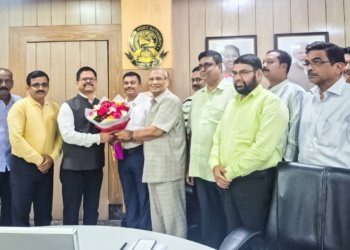


The Society for Indian automobile manufacturers (SIAM) organised its 9th automotive logistics conclave at the Hyatt Regency, New Delhi, yesterday. The theme of the conclave was Road to Sustainability: The Future of Automotive Logistics. The conclave was well attended by the private sector across the supply chain. There were representatives from APLL VASCOR Automotive Pvt Ltd, IVC Logistics Ltd, Maruti Suzuki India Ltd , Mahindra & Mahindra Ltd, TCI, to name a few. There was a battery of officials from the various departments of the Government including Ministry of Road Transport and Highways, Department for Promotion Of Industry And Internal Trade (DPIIT). It was a testimony to the importance of this conclave. There was a robust exchange of ideas that led to a number of valuable suggestions and observations.
Some of the suggestions that were that there should be more integration of data among the various government agencies.
There should be development of access controlled dedicated truck lanes on national highways and expressways.This was to allow access to increased dimensions of auto carriers operating on expressways.
Implementation of in motion railway weighbridges at the entry point of national highways and expressways to monitor overloading of trucks without stopping them, should be considered. Rakesh Sen, Chairman Logistics Group & Vice President Mahindra & Mahindra Ltd, felt that implementation of such technology was very much possible.
There should be a single helpline on a pan India basis fir roadside assistance.
Increase the number of Dedicated Freight Corridors (DFC) across the country should be considered. Create conducive support infrastructure at ports to attract automobile traffic for coastal movement.
Vinod Aggarwal, President, SIAM and CEO & MD Volvo Eicher Commercial Vehicles Ltd said that today the Indian logistics costs was as high as 14% GDP as compared to 8 to 9% in other countries. The aim of the National Logistics Policy was to reduce to a single digit. The overall logistics costs works out to USD 400 million per annum and 62% of this cost was in transportation, 34% in warehousing and the balance were as administrative costs. There was indeed scope to reduce these costs. In the transportation costs the major share was ascribed to road transportation which was pegged at 65%, the rail cost was 26 % and the balance 9% for other modes. With improved road infrastructure, the trucks could travel larger distances. As against the current movement of 7000 to 8000 km, there was the potential to go 25000 km. This could be done with modern trucks which were very efficient. Higher productivity could be used by effective use of telematics. If all the trucks are connected there can be better truck management. There was a need to replace old trucks. It was a myth new trucks will increased the costs. The cost of acquisition accounted for only 20% of the overall cost. There was a lack of parking space and restrooms for drivers. The shortage of drivers was a recurring problem. The was an imperative need not only for enhanced payment for drivers, but also to ease their work environment. There was a need for skilling, pension plans and health insurance for the drivers.
E. Srinivas, Joint Secretary (Logistics) DPIIT, Ministry of Commerce & Industry said that India has been taking numerous steps since 2015 to improve its logistics efficiency and improve in the logistics ranking. India improved by 6 digits. The target was to come in the first 25 rankings of the Logistics Performance Index by 2050. He highlighted the various initiatives taken by the Government of India to enhance the logistics efficiency in the country. The Ministry of Commerce had established the logistics division in 2018, for integrated development of the logistics sector. The task was to identify the policy changes required, identifying bottlenecks and gaps and bringing in new technology into the sector. The PM Gati Shakti was launched for building next generation infrastructure for seamless connectivity. The advantage of PM Gati Shakti was that it encompassed all the infrastructure departments in the country by being mapped to the GIS platform (Geographic Information System). This enabled any ministry to plan for building of infrastructure by providing a holistic approach.
To complement the PM Gati Shakti, the National Logistics Policy (NPL) was launched, in 2022. The policy was aimed to bring about reduction in cost of logistics. In the NPL, a comprehensive Logistics plan was developed which resulted in the creation of the Unified Logistics Interface Platform (ULIP). This enabled anyone to access whatever information available with the various government agencies across the supply chain. The platform integrated 33 logistics digital platforms across different ministries and departments. Logistic data base had been created to track the containers in the country from all the ports. All the containers were provided with RFID enabling tracking and thus providing increased visibility.
IGOT was created to provide a learning platform to the civil servants for enhanced awareness. ELOG was another site aimed at improving the service provided by the Government. ELOG provided stakeholders to register their grievances with any of the ministries.
The government was proud of the fact the the automobile industry had contributed to about 6% to India’s GDP and provided employment to around 30 million people direct and indirectly. He said that the Shakti will be provided by the government and the Gati had to be provided by the automobile industry.
Amit Kumar Gosh, Additional Secretary (LA & Highways), Ministry of RoadTransportand Highways, said the government had identified 25 high speed corridors. As of the last quarter, the Government had awarded 6812 km and completed construction of 3041 km. In order to have more seamless smooth rides on toll roads, the Government was working on the introduction of two technologies. One was the automatic reading of the car number plates and the other was the identification of the vehicle with the help of automatic global navigation system through satellites. For a country as big as India it was necessary to check out the most appropriate application of technology. The current system i.e. the Advanced Traffic Management System (ATMS) wold be undergoing a major upgrade.
Gosh asid that the Government had identified 35 MMLPs to be installed all over the country. They realised that building a small MMLPs was neither cost effective nor efficient. They estimated that they required 250 to 450 acres of land was required. But to make a MMLP functional was a major challenge, because they had to ensure that all thebl multimodal solutions were readily available. From next year onwards there would be accelerated development of MMLPs. He said that the infrastructure development had got the biggest push in the last five years, which was unprecedented.
By 2050 India would be among the three biggest economies in the world. But having saif that the gap between the first two nations and India was still very large. He called for greater interaction between SIAM and the Government in order to provide the best logistics solutions possible for the country.