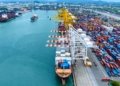
When a dockworkers union broke off contract talks with management in June, raising the likelihood of a strike at more than a dozen ports on the East and Gulf coasts that could severely disrupt the supply chain this fall, it was not over wages, pensions or working conditions. It was about a gate through which trucks enter a small port in Mobile, Alabama.
The International Longshoremen’s Association, which has more than 47,000 members, said it had discovered that the gate was using technology to check and let in trucks without union workers, which it said violated its labour contract.
“We will never allow automation to come into our union and try to put us out of work as long as I’m alive,” said Harold J. Daggett, the union’s president and chief negotiator in talks with the United States Maritime Alliance, a group of companies that move cargo at ports.
The ILA, which represents workers at economically crucial ports in New Jersey, Virginia, Georgia and Texas, has long resisted automation because it can lead to job losses.
Longshoremen have grim memories of how past innovation reduced employment at the docks. Shipping containers, introduced in the 1960s, allowed ports to move goods with fewer workers. “You don’t have to pay pensions to robots,” said Brian Jones, a foreman at the Port of Philadelphia, who said he’d vote for a strike if it came to it. He began working at the port in 1974, when bananas from Costa Rica were unloaded box by box. Asked why he was still working at 73, Jones said, “I like the action, and the money doesn’t hurt.”
Workers throughout the economy are worried that technology will eliminate their jobs, but at the ports it threatens one of the few blue-collar jobs that can pay more than $100,000. The United States has done less to automate port operations than countries like China, the Netherlands and Singapore. But the technology is now advancing more quickly, especially on the West Coast.
Automated port equipment can take many forms: Driverless vehicles can shuttle containers around the wharf. Huge cranes can stack those boxes with minimal human intervention. And “auto gates,” like the one in Mobile, process trucks.
Port operators — often subsidiaries of global shipping companies — say modernisation is needed to ensure that cargo flows efficiently and quickly to where it is needed.
Opposition from unions is just one obstacle to automation. The installation of new machinery and software can cost many millions and even billions of dollars — investments that can take years to pay off. And some ports may not have an incentive to invest in new technology when shipping companies and their customers can’t easily move to more efficient ports.
Human-free sorting
Cranes at the Port of Virginia show what machines are capable of — and have been allowed to do under existing labour contracts.
At a growing facility called Norfolk International Terminals, humans work the towering turquoise cranes that take containers off ships and place them on the wharf. Manned vehicles, called shuttle carriers, transport the containers a short distance to the base of a giant stack of containers.
Once containers are on the stack, however, many large, rail-mounted cranes shaped like upside-down U’s work nonstop to sort the containers. This task does not require human operators.
Later, a person in a control center works these cranes to take containers off their stacks and place them onto waiting trucks.
Stephen Edwards, the Port of Virginia’s CEO, said the automated technology had helped the port perform well in 2021 and 2022, when U.S. ports were struggling to process a surge of container shipments. It also came in handy this year, when cargo was diverted from Baltimore after a container ship hit a bridge and the city’s port temporarily suspended most operations.
“The semi-automated operations proved themselves all the way through the pandemic,” Edwards said.
But he also stressed that Virginia had expanded in other ways, including by strengthening berths to hold larger ships; dredging deeper and wider channels; building a new rail yard; and widening nearby highways.
Impact on jobs is unclear
The ILA declined to make Daggett available for an interview and did not answer written questions.
The union’s expiring contract allows for “semi-automated” machinery, but bars equipment “devoid of human interaction.”
The truck gate at Mobile, operated by APM Terminals, a division of Maersk, the Danish shipping giant, has existed since the terminal opened in 2008. It uses a combination of digital scans and checks performed by ILA members, according to a person familiar with its operations, who was not authorized to publicly discuss the gate because of the fraught state of contract negotiations.
Whether the use of automated machines is significantly reducing demand for union labor is unclear. Port operators say they are creating new types of union jobs, including maintaining and repairing automated machinery. They also assert that ports can employ more workers if technology allows them to handle more cargo.
At West Coast ports, where automation is more advanced than on the East Coast, the number of registered union workers has risen 12% since 2020, to 16,400 longshoremen, according to data from the Pacific Maritime Association, which represents port terminal operators. The United States Maritime Alliance, the East Coast operators group, does not publish an equivalent figure. In a filing with the Labor Department, the ILA said it had 47,412 members, up 15% from 2020.
Edwards, standing in a control tower looking down at Virginia’s operations, said, “This builds jobs, because you’re building a big economic engine.”
Federal labor filings show that the membership of the four local branches of the ILA in Norfolk grew 17% from 2018 to 2023, to nearly 3,400 workers.
When asked on a brief phone call whether automation had helped the Port of Virginia to grow and hire more union members, Larry Bachtell, a vice president in the union’s Atlantic Coast division, said, “It’s not cut and dried,” but declined to elaborate.
Coastal differences
On the West Coast, the International Longshore and Warehouse Union accepted fully automated machinery in its 2008 contract. That has allowed, among other things, the use of driverless container vehicles within the Port of Long Beach.
For the most part, West Coast dockworkers receive better pay and pensions than union workers at the East and Gulf Coast ports. Under the latest West Coast contract, agreed upon last year, longshoremen earn $54.85 per hour and, on average earned $218,000 last year, including overtime and higher wages for evening and night shifts, according to management.
East Coast longshoremen now earn $39 per hour. Management does not disclose a figure for average earnings for longshoremen, but a report from an agency that helped oversee the Port of New York and New Jersey showed that 57% of the longshoremen at the port made $100,000 to $200,000 in the 12 months through June 2020, the latest figures available.
The ILA and the United States Maritime Alliance, which declined to comment, may yet reach a deal without a strike. The management group said last month that it had offered to carry over the language on technology in the expiring contract into the new one.
But the threat of a strike is haunting businesses that rely on the ports because the union leaders and management have held no talks for weeks, and their contract ends Sept. 30.
Some companies have begun diverting shipments to the West Coast. If more start doing so, it could cause significant delays, leading to a spike in shipping costs. Some three-fifths of container shipments come through the East and Gulf coasts, far too many for the West Coast to fully absorb. A strike could be averted or ended if the Biden administration invokes the Taft-Hartley Act to force management and union leaders to strike a deal.
“I think the two sides are far apart. That’s what worries me,” said Mia Ginter, a director who oversees ocean exports at C.H. Robinson, a logistics company. “I think the best chance of avoiding a strike is the government stepping in and getting involved in this one.”
A Biden administration official said both parties ought to negotiate in good faith, adding that the administration had never invoked the Taft-Hartley Act to break a strike and was not considering doing so now.