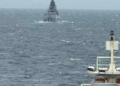


Two very large crude carriers laden with Saudi Arabian crude were hit by unidentified projectiles minutes apart while exiting the Strait of Hormuz, marking a fresh escalation in attacks along one of the world’s most critical oil chokepoints.
What happened in the attacks?
Reuters reported, citing data from maritime information providers Marisks and Kpler, that the two VLCCs were struck on the night of August 31 while transiting the Strait. One vessel, the Senegal Prosperity, a Liberian-flagged VLCC operated by South Korea’s Jang Kum Maritime, was hit by three unidentified projectiles roughly 17 nautical miles east of Khasab, Oman. All crew members were reported unharmed. The United Kingdom Maritime Trade Operations (UKMTO) separately confirmed that a tanker exiting the Strait came under attack three times in the same waters.
A second vessel, the Sidr, operated by Saudi shipping company Bahri, was struck at a point roughly 16.6 nautical miles from Khasab. Both tankers had loaded 2 million barrels of crude oil each at Saudi Aramco’s Ju’aymah terminal the previous week, part of Aramco’s resumed crude loading and sales through the Strait since August. Marisks noted that the near-simultaneous nature of the attacks signals escalating security threats within Oman’s maritime corridor.
Why were these tankers targeted?
The attacks followed a sanctions warning from Iran targeting tankers, including those operated by Jang Kum Maritime, over alleged violations of transit rules in the Strait of Hormuz. The Persian Gulf and Strait Authority (PGSA), a newly established body overseeing the Strait, published a list of 45 targeted vessels on X on August 23, warning of possible fines or cargo seizure. Five Jang Kum Maritime ships appeared on that list alongside other VLCCs and LNG carriers, and Iranian authorities have signalled further sanctions against vessels involved in ship-to-ship transfers and shuttle operations moving crude to tankers waiting outside the Strait.
Why is Jang Kum Maritime pressing ahead despite the risk?
Despite the escalating threat environment, Jang Kum Maritime has pursued an aggressive fleet expansion through the Middle East crisis, purchasing 73 secondhand tankers this year for approximately 8.2 trillion won ($5.9 billion), making it the world’s largest tanker buyer in 2026. That spending figure matches the combined outlay of the second- through ninth-largest buyers combined. As a key crude transport partner for Aramco, the company has taken on elevated route risk to capture high-margin Middle East business.
Jang Kum Maritime is wholly owned by Jung Ga-hyun, a director and the eldest son of Sinokor Merchant Marine Chairman Jung Tae-soon. The company is also currently the subject of an MSC bid for a 50% stake, a deal already cleared by Greek competition authorities and now under review by South Korea’s Fair Trade Commission.
What does this mean for tanker traffic through Hormuz?
The near-simultaneous strikes on two VLCCs carrying Saudi crude underscore that risk in the Strait of Hormuz remains active and unpredictable, even as Aramco has resumed loadings through the corridor. For operators like Jang Kum Maritime, who are betting heavily on continued Middle East crude flows, the attacks add fresh pressure to route-risk calculations at a moment when Iranian sanctions threats and physical attacks are converging on the same vessels.