

• About
  • Advertise
  • Careers
Wednesday, November 11, 2026
Maritime Gateway
Advertisement
  • Home
  • Shipping
    • NVOCC
    • Tankers
  • Cargo
    • Air Cargo
    • Container Cargo
    • Dry Bulk
    • Liquid Bulk
    • LNG
    • Project Cargo
  • Global News
    • Africa
    • Americas
    • Asia
    • Europe
    • Middle East
  • Ports & Terminals
    • Bulk Ports
    • Container Terminals
    • Port & Terminal Equipment
  • Logistics
    • Freight Forwarding
    • Logistics Parks
    • Supply Chain
    • Warehousing
  • Transport & Multimodal
    • Multimodal Transport
    • Rail
    • Trucking
    • Inland Waterways
  • Insights
    • Magazines
    • Interviews
    • Reports
    • Newsletters
    • Webinars
No Result
View All Result
Maritime Gateway
No Result
View All Result
Home
News

Ukraine crisis redraws oil trade routes

by Kalpana Pandey
September 29, 2022
in News, Asia, Europe, EXIM & International Trade, Liquid Bulk, Logistics, Supply Chain
Reading Time: 3 mins read
A A
oil tanker

China’s Asian neighbours are soaking up surplus crude volumes and creating new routes in the process, writes Tim Smith, Director, Maritime Strategies International.

Crude trade volumes in 2022 are seeing conflicting dynamics. The historical ‘engine’ of growth, China, is contracting. We expect China’s import volume growth to be negative for the second consecutive year, dropping by 0.7%.

Given the country’s weak demand and well publicised, and intensive, fight against COVID-19, this will come as little surprise. More at risk is our view that imports will see a big increase in 2023.

Chart 1 shows crude flows into China through July from key regions, with a significant decline evident across Q2. Q3 has seen some pick-up but volumes remain low in a historical context.
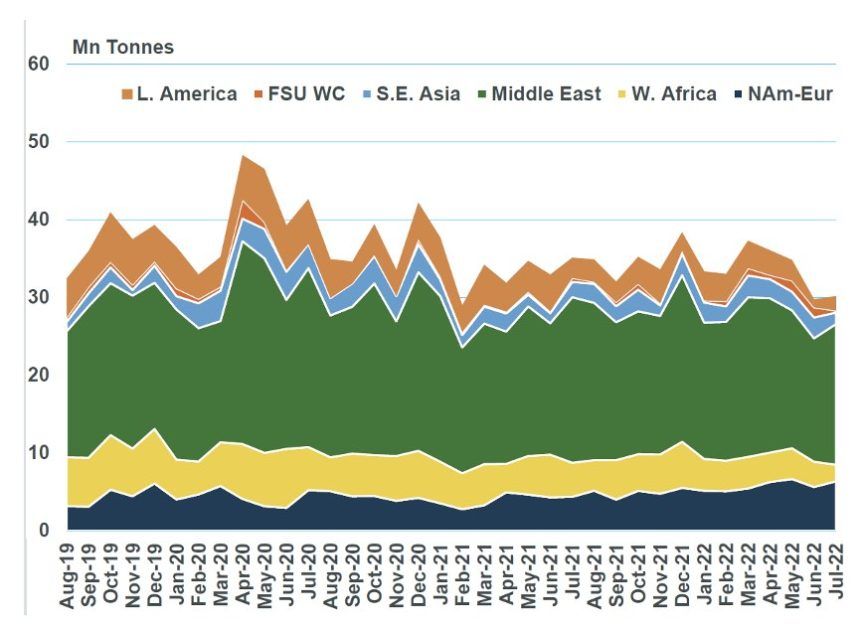
chart 1

However, whilst China has been in the doldrums, other regions have been soaking up crude. We have made significant upward revision to European and South Asia crude imports in 2022 helping offset the impact of China and continuing to drive crude tanker demand higher. The major Asian economies of Japan, South Korea and India are all seeing substantial increases in imports this year, supporting our view on net crude trade growth of 4.5% in 2022.

This ‘volume’ factor is key in explaining the revival in tanker markets – it is not all about changing route dynamics. Adjusting for overland flows, seaborne crude trade volumes are also revised up, with the 2022 growth rate increased from 3.9% to 5.1%.

RelatedPosts

New post style guide

Paradip Port Targets 170 MMT Cargo as PPA Reviews Infrastructure and Operational Efficiency

Edgistify Adds 68,000 Sq Ft Warehouse at IndoSpace Luhari to Expand Gurugram Network

National Strategic Trade Command Centre Opens to Strengthen India’s Export Oversight

As Chart 2 shows, Europe and North America are also playing a major role in the positive growth of crude trade in 2022 with European import growth particularly notable. However, we don’t expect this to last.
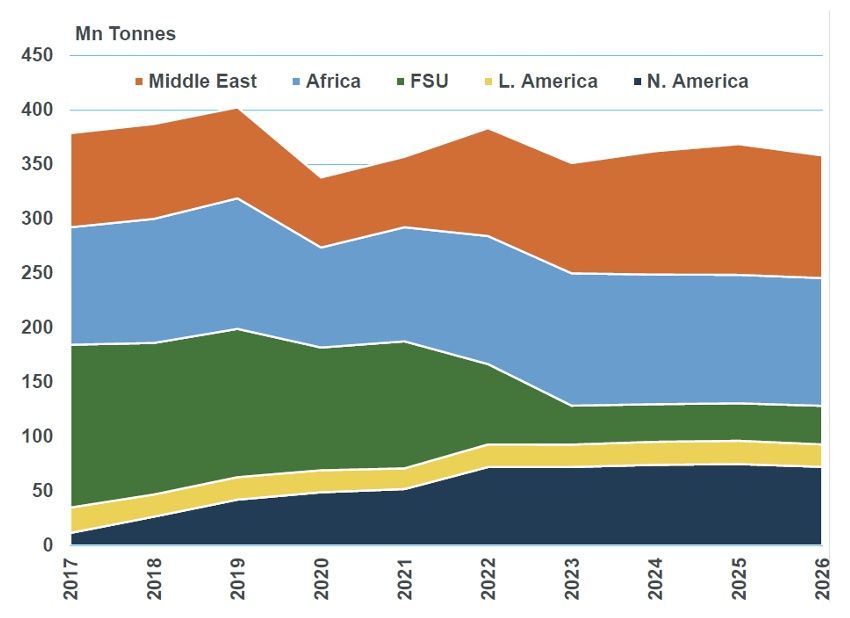
Chart 2 1

Much like our forecasts for overall consumption, 2023 is expected to see crude trade growth drivers switch dramatically.

Europe’s ban on seaborne Russian crude is expected to pressure import volumes next year; even though we have revised up overall levels (from a higher base in 2022), we still project a net decline in the region’s crude imports.

In terms of Europe’s sourcing of crude, we expect to see a major switch in the latter part of 2022 – the EU’s ban on seaborne crude comes into effect on December 5th. Our projections for flows combine an overall decline with more weight now added to African imports which have been growing strongly, alongside Middle East and US crude imports.

FSU imports still contribute to the region’s intake as other countries comprising the region, e.g. Kazakhstan, are not affected by the ban. Nonetheless, outlets for these countries’ crude are subject to related disruption with the CPC pipeline that moves crude into the eastern Mediterranean being subject to Russian interference.

Stronger Chinese crude import demand in 2023 is predicated on both COVID-19 policy easing and limited macroeconomic downside – neither are guaranteed – supporting VLCCs. Seaborne crude cargo is expected to reach pre-pandemic levels by 2024 and during 2024/25 trade growth reverts more closely to pre-pandemic ‘norms’ with volumes driven by China/Asia. At the same time, Americas import demand declines as domestic production rises and demand growth slows. However, with Russia’s invasion of Ukraine, we should only refer to any ‘normal’ in a limited context. The oil market map has been changed permanently. Oil tankers are likely to continue to benefit from this restructuring and with markets all but shut off in Europe and North America, Russian crude must, if is to continue to be produced and exported, head primarily to Asia supporting tonne miles.

Tags: Russia Ukraine war
Previous Post

Mr. Nimal Siripala de Silva: PPP vital to develop ports, shipping and aviation sectors

Next Post

JCorp and Sojitz take up decarbonisation initiatives in Johor

Kalpana Pandey

The Maritime Gateway Editorial Team delivers trusted news, analysis, and insights on shipping, ports, logistics, supply chains, and global trade, backed by industry expertise and editorial review.

Next Post
India, Denmark to jointly carry out R&D on green fuels

JCorp and Sojitz take up decarbonisation initiatives in Johor

Follow Maritime gateway

    Popular News

    New post style guide

    New post style guide

    October 27, 2026
    Paradip Port Targets 170 MMT Cargo

    Paradip Port Targets 170 MMT Cargo as PPA Reviews Infrastructure and Operational Efficiency

    October 16, 2026
    Haryana CM flags off first goods train

    Haryana CM flags off first goods train from rail yard at Integrated Multi Modal Logistics Hub in Mahendragarh district

    August 24, 2026
    Hooghly Cochin Shipyard Wins Repeat Order for Two Luxury River Cruise Vessels

    Hooghly Cochin Shipyard Wins Repeat Order for Two Luxury River Cruise Vessels from Antara

    October 10, 2026

    Business

    No Content Available

    recent

    New post style guide

    New post style guide

    October 27, 2026
    Paradip Port Targets 170 MMT Cargo

    Paradip Port Targets 170 MMT Cargo as PPA Reviews Infrastructure and Operational Efficiency

    October 16, 2026
    Edgistify Adds 68,000 Sq Ft Warehouse

    Edgistify Adds 68,000 Sq Ft Warehouse at IndoSpace Luhari to Expand Gurugram Network

    October 16, 2026
    National Strategic Trade Command Centre Opens

    National Strategic Trade Command Centre Opens to Strengthen India’s Export Oversight

    October 16, 2026
    India’s Merchandise Exports Rise 23%

    India’s Merchandise Exports Rise 23% as First-Half Earnings Reach $259.89 Billion

    October 16, 2026

    Latest Shipping and logistics news covering marine, Ports, Shipping, Logistics, containers, dry bulk & tankers that drive South Asian maritime Industry.

    Site Links

    • Interviews
    • News
    • Government
    • Shipping
    • Cargo News

    Site Links

    • Interviews
    • News
    • Government
    • Shipping
    • Cargo News

    Follow Us

    © 2026 – Powered by .

    • Terms of Use
    • Privacy Policy
    • Manage Cookies
    • License
    No Result
    View All Result
    • Home

    © 2026 JNews - Premium WordPress news & magazine theme by Jegtheme.